
On August 15th, we opened our nets for our 25th fall season! It’s hard to believe that what started as the random daydreaming of an avian field technician has not only persisted for 25 years, but blossomed into south Florida’s premier site for gaining experience in mistnetting. Our volunteers hail from all across south Florida and we frequently host visitors from all across the state!
As it is the beginning of the season, we figured we should shine a spotlight on the work that leads up to opening. When we closed our nets in spring, we surrendered our trails back to the vegetation of Key Biscayne. The summer rains typically trigger an overgrowth of lush green vegetation in the understory of the banding area. Strong winds can blow over large limbs that have been decaying in place, creating new road blocks and openings.
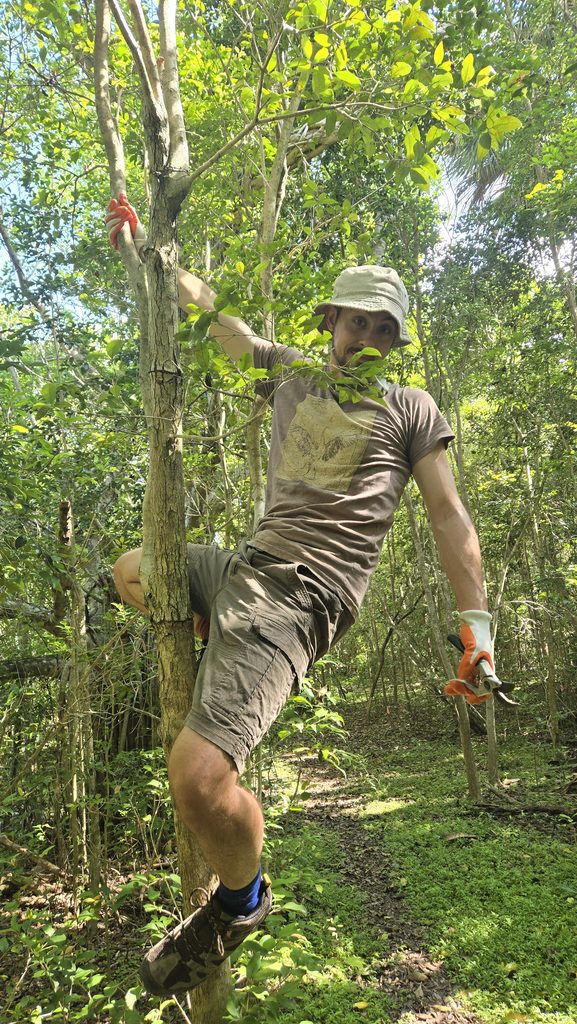
In anticipation of thousands of guests, we must get our house in order.
Several days prior to the beginning of the season, a crew of volunteers comes out to the station and, in partnership with the park biologist, Liz Golden (also one of the co-founders of our station), begins the arduous, humid, and precise work of trimming back the vegetation – never more than necessary, and always taking extreme care to preserve the unique nature of the flora that has makes this location attractive to the very birds we are preparing to capture. This year has been exceptionally dry, reducing the need for bushwhacking, but this was still no walk in the park. For those of you who have never experienced the wonder of South Florida in early to mid-August, I envy you. These days are long, hot, and sticky, compounded by the incessant buzzing of mosquitos in our ears. Once the trails and net lanes are sufficiently clear, it is time to actually prepare for hanging nets.
This season, this task was especially laborious as it was time to replace several pieces of narrow and rusted rebar and metal conduit. Even with gloves on, our crew walked away battle scarred from the intense effort of pulling 2.5 ft of rebar out of the ground where it had rested for several years. This also gave us an opportunity to adjust poles that may have been tilting inwards, or placed too close together, causing the net to droop. We also always have the pleasure of setting up our canopy rigs, which take about 30 minutes each to prep, lift, and tie off so we can hoist a couple of nets 20 feet up in the air.
Only after that back-breaking work was done (which alone took nearly 6 hours of continuous work) could we begin to actually hang nets. This was an especially exciting part of the work this season as we were able to replace many of our nets thanks to the generosity of Give Miami Day donors and grants from the Friends of Cape Florida and the Key Biscayne Rotary Club. As these new, matte-black nets were hung and unfurled for the first time, we all breathed a sigh of relief -after the equivalent of 73 hours of work under high heat advisories, everything was ready for the Saturday crew to start on schedule with all nets open. This is no small feat, and we often don’t quite meet this target, putting up the canopy nets sometime in the first couple of weeks of the season instead of having them ready on day one. It’s always gratifying to see the nets all start working from day one.
And start, they did! We’ve had a surprising amount of movement for this first week of banding. It almost makes the heat worth it. Thankfully the fall season always starts a little slow; this gives us time to fine tune our set ups, refresh our memories on protocols, and train new volunteers. Next week, we’ll share more about some of the early migrants we’ve encountered!
Fall 2026 Totals (Aug 15 – Aug 24)
| SPECIES | NEW | RETURN |
| Common ground dove | 1 | |
| Traill’s flycatcher | 1 | |
| Red-eyed vireo | 2 | |
| Blue-gray gnatcatcher | 3 | 1 |
| Northern parula | 2 | |
| Prairie warbler | 4 | |
| Black-and-white warbler | 8 | |
| American redstart | 30 | |
| Prothonotary warbler | 4 | |
| Swainson’s warbler | 1 | |
| Ovenbird | 15 | |
| Northern waterthrush | 1 | |
| Louisiana waterthrush | 1 | |
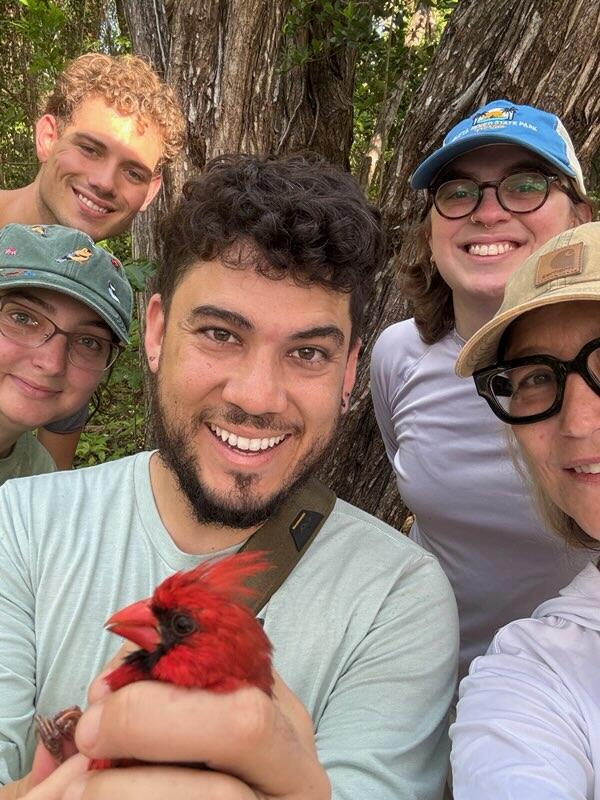
| Northern cardinal | 0 | 3 |
| TOTAL | 73 | 4 |
| # BIRDS CAPTURED | # SPECIES | # NETS | NET HOURS | CAPTURE RATE (BIRDS/100 NH) | |
| SEASON TOTAL | 77 | 14 | 25 | 1190.5 | 6.972 |